2026 promises to hold important economic developments in areas from tax policy to student loans. Below, experts from Brookings’ Economic Studies program share the issues they’ll be watching.
Health care and nutrition assistance changes
Legislation enacted in 2025 made deep cuts and major structural changes to Medicaid, the Affordable Care Act (ACA) marketplaces, and the Supplemental Nutrition Assistance Program (SNAP). With some of these policies taking effect in 2026, I’ll be watching how they’re implemented and how they impact health coverage, food insecurity, and financial hardship.
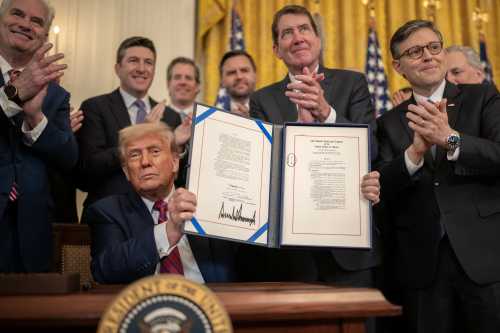
Several of the One Big Beautiful Bill Act (OBBBA) health care cuts take effect January 1, 2026, including policies making it harder for low-income people to sign up for ACA coverage and ending ACA tax credit eligibility for hundreds of thousands of low-income, lawfully-present immigrants. In addition, policymakers’ decision to let enhanced ACA tax credits expire—even as the OBBBA continued $3.9 trillion in other expiring tax cuts—will raise premiums starting in January. The Congressional Budget Office (CBO) projects that health care changes taking effect in 2026 will ultimately cause about 5 million people to lose health insurance; the first official data reflecting these changes, from the National Health Interview Survey, would typically come out this summer. Likewise, CBO projects that more than 2 million people will lose access to SNAP in a typical month as a result of OBBBA’s expanded work requirements; the first enrollment data reflecting these provisions should come out this year.
Meanwhile, state policymakers will face decisions this year about how to implement and respond to additional large cuts that will take effect in 2027. These include novel Medicaid work requirements that will end eligibility for most non-elderly adults unless they’re working 80 hours per month, jeopardizing coverage for anyone who loses their job or is employed but with unstable hours, as well as for retirees under age 65. State legislative sessions will likely also be dominated by decisions about whether and how to respond to OBBBA’s new requirement that states pay for part of the cost of SNAP benefits. States will have to decide whether to cover that cost—presumably by raising state taxes or cutting other programs—or refuse to do so, which would end their residents’ access to SNAP.
The Hamilton Project will be tracking these decisions and their effects, especially how they play out amidst broader economic uncertainty. A weakening labor market would raise the stakes of OBBBA’s already monumental health care and safety net cuts: It would increase the need for Medicaid, ACA tax credits, and SNAP; make it even harder for vulnerable people to meet 80-hour per month work requirements; and reduce state revenues as states decide how to respond to federal funding cuts.
Immigration and labor markets
In 2026, I will be closely following how reduced immigration flows reshape labor markets—tracking both labor supply and labor demand effects, and how observers interpret a jobs picture that looks nothing like recent history.
The dramatic decline in immigration has fundamentally changed what constitutes healthy job growth. Average monthly employment growth has been just 17,000 since April—a level that historically would signal a labor market in crisis. Yet the unemployment rate has only modestly ticked up. This apparent contradiction exists because the sustainable pace of job creation has collapsed. With fewer immigrants entering the labor force, the economy needs far fewer new jobs to maintain balance. Analysis I recently published with Tara Watson and Stan Veuger estimates that healthy job growth could fall to zero or even turn negative by 2027.
But labor supply is only half the story. For example, reduced immigration also means reduced consumer spending. The immigrants who aren’t here aren’t just not working—they’re also not spending across the U.S. economy. I’ll be watching where supply-side and demand-side effects show up across sectors and regions, particularly in construction and in services in communities with historically large immigrant populations.
Perhaps most worth watching will be how observers interpret the data. Policymakers, markets, and the media are conditioned to view monthly job growth of 20,000 as a terrible omen—a sickly labor market or impending recession. But if current immigration policies continue, this may simply be the new sustainable pace. Getting this interpretation wrong has real consequences: It could lead the Federal Reserve to misjudge monetary policy or cause businesses to make decisions based on outdated frameworks for a healthy labor market.
Retirement security
One policy issue I’ll be watching closely in 2026 is the future of U.S. retirement security, particularly how legislators position themselves on Social Security’s financing challenges and the possibility of new reforms to the private retirement savings system.
The Social Security Trustees and the Congressional Budget Office have repeatedly warned that the Old Age and Survivors Insurance trust fund is projected to deplete its reserves, with the Social Security Trustees most recently warning that exhaustion is expected in 2033. While the exact depletion date shifts slightly with each annual report, the overall message is unmistakable: Projected benefits significantly exceed projected revenues. Though it has been tempting to blame waste, fraud, and abuse for the program’s financial troubles, it is clear that strengthening the program’s future will involve difficult tradeoffs in terms of reduced benefits and/or higher revenues, and the window for gradual, less disruptive reform is narrowing.
This year, the political pressure to address Social Security’s financial troubles will intensify. Senators elected in 2026 will have no choice but to address the looming insolvency during their 6-year term, and may float trial balloons on revenue options, benefit adjustments, or hybrid approaches to address the financial shortfall the program faces. An engaged public can ensure that legislators put forward sensible solutions to put the program on solid footing for future generations.
Congress is also poised to take on the private retirement savings system through SECURE 3.0, building on the bipartisan momentum of the 2019 and 2022 laws. Earlier rounds expanded access to workplace plans, boosted automatic enrollment, and enhanced catchup contributions, but issues remain. The Brookings Retirement Security Project is developing the next generation of policy ideas for SECURE 3.0 legislation by curating proposals among retirement policy experts that address persistent gaps in retirement security. Together with activity related to Social Security reform, these developments in 2026 will shape the retirement landscape for years to come.
Russian oil sanctions
In 2026, I will be watching the extent to which policymakers quicken an end to the war in Ukraine through increased sanctions on the Russian oil trade. The first year of the Trump administration marked a sharp departure from the approach taken by the previous administration. While President Biden sanctioned 216 Russian shadow fleet tankers between February 2022 and January 2025, President Trump has yet to sanction a single one—even while the European Union and United Kingdom have sanctioned 482 and 435 vessels, respectively, since Trump’s inauguration. This stagnation occurred even in the face of mounting evidence that U.S. sanctions on oil tankers have an outsized impact relative to sanctions from other jurisdictions.
In lieu of tanker-based sanctions, the Trump administration has taken two other notable steps to punish the Russian oil trade. The first is to levy a 25% incremental tariff on Indian exports to the U.S. as a penalty for India’s massive purchases of Russian oil, which swelled from less than 100,000 barrels per day prior to the invasion to 1.8 million barrels per day on average in 2025. The second is to sanction major Russian oil companies Rosneft and Lukoil, which was announced in October of 2025 and appears to have had a substantial impact on energy markets, namely a widening spread between the price of Russian oil and comparable oil from other sources. In addition, the Trump administration threatened secondary sanctions on purchasers of Russian oil, which could lead to declines in traded volume—as opposed to simply price—should they go into effect.
Congress may also take action. The most prominent prospective legislation is a pending bill, sponsored by Senators Graham (R-SC) and Blumenthal (D-CT), which would levy 500% tariffs on any country purchasing Russian oil. Such a high tariff rate is tantamount to a trade embargo and would lead to some combination of precipitously higher energy prices, sharply lower international trade, and/or drastically reduced Russian revenue. Last week, Senator Graham announced on social media that the legislation—which has 84 bipartisan co-sponsors—has the support of the White House and could face an imminent vote in the Senate.
Lastly, sanctioning authorities in Europe may continue to ratchet up pressure on Russia. In particular, maritime nations bordering the Baltic Sea and Black Sea may more aggressively demand that tankers carrying Russian oil adhere to regulations concerning insurance and safety provisions. Such a move would not only protect their coastlines from an oil spill caused by aging and poorly maintained tankers in Russia’s shadow fleet, but it would also push more of the oil trade back under western services where it would be subject to price caps established in 2022.
U.S. trade policy
In 2026, I will be watching the continuing saga of U.S. trade policy, specifically how it filters through the U.S. economy and reshapes relationships with trading partners. U.S. trade policy experienced an unprecedented shift in 2025: The average U.S. tariff rate rose to about 17%—far above the less-than 3% rate that prevailed for most of the past three decades. Beneath that headline number, however, lies a more complex landscape: which industries are receiving protection and how tariff treatment varies across countries. These details will shape how trade policy ultimately affects the U.S. economy.
Thus far, higher tariffs appear to be a headwind for the U.S. economy but one it has largely been able to absorb. Trade flows have not fallen off a cliff; despite nontrivial upward price pressure from tariffs, inflation has not materialized to the degree feared; recession concerns have eased; and the dollar’s global role has proven resilient. Businesses may have stocked up in advance and delayed price increases or supply-chain shifts amid uncertainty over which tariffs will remain in place, particularly given that many imposed under the International Emergency Economic Powers Act (IEEPA) are now under Supreme Court review. Moreover, the broadest tariff increases only took effect toward the end of 2025; if elevated tariff levels persist into 2026, some of these dynamics may begin to shift.
Predictions of widespread retaliation have likewise failed to materialize. Only China has imposed and sustained substantial retaliatory measures in response to new tariff actions. Instead, many U.S. trading partners have entered negotiations over so-called agreements on “reciprocal trade,” trading tariff relief for commitments to lower their own tariffs, address non-tariff barriers, and accept more novel provisions requiring purchases of U.S. goods, investment in the United States, and alignment with U.S. economic security measures. Uncertainty remains, however, because these arrangements are not congressionally approved trade agreements—raising questions about the durability of this emerging trade framework.
Crypto regulation and financial stability
The financial system is changing rapidly due to technological advances, such as lower-cost computing and cryptography, as well as changes in investor behavior and regulations. In 2025, Congress passed breakthrough legislation for payment stablecoins, federal bank regulators provided guidance for banks to engage in crypto-asset activities, and the Federal Reserve signaled openness to offering limited access to its payment rails for some federally regulated stablecoin issuers. These actions have created a foundation for a faster, more efficient, and more functional U.S. payments system. At the same time, regulators have set a broader agenda to cut back supervision and capital requirements that they view as unnecessarily restraining growth and stifling innovation. Combined, these developments mean that actions in 2026 will be critical in determining how growth and innovation can be achieved without raising risks to the core of the U.S. financial system—money and payments, and the largest banks—and to U.S. global financial leadership.
The GENIUS Act, passed in July 2025, establishes a new regulatory framework for payment stablecoins, a privately offered digital payment asset recorded on a distributed ledger backed by U.S. currency or similarly liquid assets, that could be used as a substitute for cash or bank transaction accounts. Stablecoins enable faster, and potentially programmable, payments with smart contracts than payments settled with legacy infrastructure. Growth of USD-backed payment stablecoins could also strengthen the global use of the dollar and increase demand on net for Treasury bills, possibly reducing the government’s interest costs.
While the GENIUS Act provides more certainty, financial regulators must now write rules that will determine if these stablecoins can gain trust and be used for purposes other than trading crypto-assets. Stablecoins can be offered by nonbanks or bank subsidiaries and will compete with tokenized bank deposits and real-time fast payments offered by banks.
As highlighted in my recent analysis, regulators need to write rules to ensure the “singleness of money,” i.e. that a stablecoin trades at par, and can be redeemed for cash in whole and on demand. Given that GENIUS permits reserve assets that are risky and illiquid, including uninsured bank deposits and secured borrowing by the stablecoin issuer, regulators will need to carefully set capital, liquidity, and risk management requirements to ensure stablecoins are valued continuously at par. Otherwise, there could be runs on stablecoins and forced liquidation of the assets that back them, disrupting payments and financial stability. Another critical step for regulators is to immediately ensure compliance with anti-money laundering rules, and within three years, issue guidance for heightened standards for risk management and use of innovative or novel methods to detect illicit activity.
In addition, the Federal Reserve recently requested comments on granting limited access to the Fed’s payment rails for federally regulated stablecoin issuers with bank charters. Access even on a limited basis would permit settlement of stablecoins for fiat currency on the Fed’s payment rails, which could reduce settlement risks and enable greater competition in payments services.
In December 2025, the Office of the Comptroller of the Currency conditionally approved five national trust bank charter applications by nonbank financial firms. Commercial banks are also actively developing their crypto-asset strategies, including issuing stablecoins or tokenized deposits to keep their depositors and offering digital wallets or other services to customers to handle, send, and receive crypto-assets. This work accelerated after the federal banking regulators withdrew previously issued supervisory guidance in 2025 and issued a new statement on risk management considerations for banks’ engagement in crypto-asset activities. However, regulators are also slashing supervision and considering proposals that could meaningfully reduce capital at the largest banks, at a time when caution is warranted as asset valuations are elevated, financial stresses at some households and businesses are emerging, and operational risks at banks, including from new crypto activities, are increasing.
Congress also has been working on a regulatory framework for unbacked crypto assets, focusing primarily on whether they are securities or commodities. While progress is being made on investor protection, more attention needs to be paid in 2026 to how distributed ledger technology could transform financial services in coming years. One issue is rules for tokenized securities, which could bring significant efficiency gains in underwriting and trading securities native to a blockchain. A second is whether stablecoins can pay rewards through an affiliated or third-party digital asset platform, which could divert the use of stablecoins for digital payments or draw away deposits from banks, reducing their bank loans to small businesses.
Tax policy after OBBBA
With the One Big Beautiful Bill Act (OBBBA) enacted, the focus now shifts to implementation, expiring provisions, and whether its incentives operate as intended. In 2026, attention will move from political rhetoric to evidence, with agencies clarifying how the law will be carried out and early economic responses beginning to emerge.
A key question in this implementation phase is whether OBBBA’s pro-investment provisions meaningfully change firm behavior. While the legislation was framed as encouraging new investment, existing tax rules, financing conditions, and uncertainty around tariff policy may limit how responsive firms are to those incentives. As recent analysis has shown, interactions with depreciation rules and other features of the tax code could blunt their effect. Early investment data should begin to clarify whether these provisions drive additional investment.
Beyond OBBBA, expiring and unresolved tax provisions are also likely to shape the 2026 policy agenda. The Work Opportunity Tax Credit is again scheduled to expire, continuing a pattern of temporary extensions despite limited evidence of effectiveness. More consequentially, enhanced premium tax credits remain unresolved, even as premiums have already risen and coverage affordability has deteriorated for many households. In response, some policymakers have suggested alternative policies such as government-funded health savings accounts. However, prior analysis suggests that expanding Health Savings Accounts risks higher costs and regressive benefits, rather than addressing underlying problems in the health insurance market. Pressure to rely on expedient workarounds instead of durable policy solutions is likely to intensify.
Political and institutional constraints will further shape how these issues play out. With the 2026 midterms approaching, lawmakers will face growing pressure to make tax pledges that could constrain their ability to respond to evidence or adjust course. At the same time, trade policy remains unsettled, with ongoing tariff actions and a looming Supreme Court case creating additional uncertainty for firms. These debates will evolve alongside broader fiscal pressures, including a 2026 deadline to reauthorize the Highway Trust Fund, the longer-term fiscal cliff created by the OBBBA, and the narrowing window to address Social Security’s long-term financing.
Student loans
The One Big Beautiful Bill Act (OBBBA), signed into law in July, will significantly limit how much graduate and professional students can borrow and overhaul the student loan repayment system for both new and existing borrowers. Effectively managing the Student Loan Program through the transition will be a challenge for the Department of Education (ED), especially considering its staff has reportedly been cut by nearly half. I’ll be watching to see if the Department of Education can get the loan program functioning more effectively—or at least headed in the right direction.
The Biden administration made important improvements to how the long-troubled Public Service Loan Forgiveness (PSLF) and Income Driven Repayment (IDR) programs are administered, but frequent policy changes and legal challenges have made the last several years tumultuous for the student loan program and confusing for borrowers. Legal wrangling over Biden’s new IDR plan—Saving on a Valuable Education (SAVE)—has left nearly 8 million borrowers enrolled in SAVE in limbo for more than a year. Many borrowers working for government or nonprofit employers cannot make qualifying payments towards PSLF forgiveness, and the PLSF “buy back” program that is supposed to address this issue does not appear to be working well. While ED has agreed to resume processing some applications for IDR forgiveness for eligible borrowers in legally contested plans, the backlog of applications is large and appears to be growing.
Although some borrowers will face higher payments, the changes prescribed by OBBBA should substantially simplify the repayment system for new borrowers—a welcome change for a hopelessly complex system. Successfully launching such a program would present a significant communication challenge in the best of circumstances; and ED has a mixed track record when it comes to keeping servicers and borrowers well-informed. This challenge is only amplified by legal turmoil.
In addition to overhauling the repayment system, OBBBA reduced loan limits for graduate student and parent borrowers. The lower limits for graduate students are expected to affect a quarter to a third of graduate and professional students. I’ll be watching to see whether private lenders step in to fill this gap or if new credit constraints restrict access to expensive, but lucrative, graduate programs.
Federal debt
Soaring federal debt is increasingly raising concern among economists and policy experts, even as Washington politicians largely ignore it. Since 2008, public debt has skyrocketed from 40% to 100% of GDP and is heading towards 130% in a decade and 240% of GDP within three decades if current tax and spending policies are extended.
This unsustainable debt path would bring dire consequences. First, Washington borrowing an additional $170 trillion over three decades to finance these projected deficits would push up interest rates and rob the economy of the savings needed to finance job- and income-producing investments. Second, annual interest payments on this debt—which have already tripled to $1 trillion since 2021—are projected to consume 27% of tax revenues within a decade and at least half of annual revenues within three decades. Even these figures are based on the CBO’s rosy assumption that the interest rate paid on this debt never again exceeds 3.8%.
These outcomes are widely viewed as implausible, as financial markets would likely rebel before such drastic outcomes could come to fruition. Still, substantial disruptions in financial markets—especially the massive market for U.S. Treasury debt—are likely to become more commonplace as the U.S. fiscal position erodes. Markets are already signaling an expectation of markedly higher interest rates five and ten years in the future.
Reining in this debt will almost surely require significant Social Security and Medicare reforms as well as broad-based tax increases. Yet the first rule of holes is to stop digging, and last year’s tax cut—estimated to cost $5 trillion over the decade if extended—dangerously deepened the debt hole. While Congress and the White House are unlikely to raise taxes or cut spending in an election year, responsible lawmakers should oppose expensive new legislation, extend the expiring discretionary spending caps, and begin bipartisan discussions to address the Social Security trust fund’s looming insolvency.
Finally, presidential attempts to pressure the Federal Reserve to trim debt service costs through significantly-reduced interest rates would risk escalating inflation while providing little deficit reduction. There are no easy shortcuts to fiscal sustainability, and Federal Reserve independence must be preserved.
Authors









The Brookings Institution is committed to quality, independence, and impact.
We are supported by a diverse array of funders. In line with our values and policies, each Brookings publication represents the sole views of its author(s).


Commentary
Economic issues to watch in 2026
January 13, 2026